

Grading, Drainage, and Erosion Control in Boulder: Why These Three Systems Work Together
If you’ve spent any time working in Boulder’s backyards, you know the terrain doesn’t forgive careless drainage planning. Clay-heavy soils shed water instead of absorbing it. Foothill grades send runoff moving fast. Summer thunderstorms dump inches of rain in under an hour. And spring snowmelt saturates soil that’s been frozen and cracked all winter. Effective Boulder yard drainage isn’t just a landscaping detail, It’s the difference between a yard that holds up over time and one that slowly fails at the foundation, the slope, and the planting beds all at once.
The September 2013 Boulder flood made that reality visible in the worst way possible. Residential lots with flat or misdirected grades held water against foundations. Unstabilized slopes gave way. Properties without proper drainage infrastructure took damage that went far beyond cosmetic.
At Stone & Leaf Landscaping, we’ve been working on Front Range properties since 2008, and that event confirmed what we already knew from years of field experience: grading, drainage, and erosion control are not three separate services. They are one connected system, and each one depends on the other two to work.
The Short Answer: What Boulder Yard Drainage Really Requires
Effective yard drainage requires properly graded slopes to direct water away from structures, a drainage system to move that water safely off the property, and erosion controls to protect the soil and plantings between those two points. In Boulder’s clay soils, getting any one of these wrong puts the other two at risk, and all three need to be planned and installed as a coordinated system.

Why Boulder Properties Face Drainage Challenges Other Markets Don't
Boulder’s drainage challenges are not the same as what you’d find in Denver’s flatlands or a sandy-soil market like Phoenix, and the unique climate requires professional drainage and grading solutions. Four conditions combine to make drainage failures here more damaging and harder to recover from.


First, Boulder’s subsoils are heavy with clay, which does not absorb water the way sandy or loamy soils do. When rain or snowmelt hits a clay-based yard, the water sheds across the surface rather than soaking in, meaning every drop that lands on the wrong slope goes somewhere you don’t want it.
Second, foothill grades are steep, and steep grades accelerate runoff velocity, so water moving fast carries more soil, cuts deeper channels, and hits structures with more force than slow-moving sheet flow across a flat yard.
Third, Front Range thunderstorms are intense and short, and it’s not unusual for a summer storm to drop an inch or more of rain in thirty to forty-five minutes, which overwhelms poorly designed drainage quickly, especially when the soil is already dry and hardened from a stretch of hot weather.
Fourth, spring snowmelt hits soil that spent the winter freezing and cracking, because of the freeze-thaw cycles in Boulder’s clay soils that create small channels and voids that disrupt established grades, and can redirect water in ways that weren’t anticipated when the drainage system was first designed. We’ve seen properties in Boulder and surrounding communities where grades that worked fine in October were directing water toward a foundation by April.
Stone & Leaf Landscaping has worked across Boulder County and the surrounding Front Range since 2008, giving us over 17 years of direct experience with exactly these conditions. That’s not general landscaping knowledge, it’s site-specific, soil-specific, slope-specific experience that shapes how we approach every drainage assessment we do.
If you’re seeing signs of drainage problems on your property, schedule a free on-site consultation with our Boulder landscaping team. We’ll assess your specific slope, soil, and water patterns and recommend the right solution.
The Warning Signs Your Yard Has a Drainage or Grading Problem
Most drainage problems announce themselves clearly if you know what to look for. These are the signs we see most often on Boulder-area properties:
- Water pooling near the foundation after rain or snowmelt, even briefly
- Soggy or persistently muddy lawn areas that don’t dry out between storms
- Washed-out mulch beds after heavy rain, with visible soil displacement
- Exposed tree or shrub roots on slopes, indicating topsoil has eroded away
- Soil pulling away from a foundation edge, patio perimeter, or walkway
- Retaining walls that are leaning, bulging, or showing cracks at the joints
- Basement moisture or wall seepage following wet periods in spring or after summer storms
None of these symptoms resolve on their own. In Boulder’s freeze-thaw climate, they tend to worsen each season because each winter cycle deepens existing drainage pathways and puts more stress on whatever soil structure remains. Catching these problems early is significantly less expensive than addressing the foundation damage, slope failure, or retaining wall replacement that follows if they’re left alone.
Landscape Grading: The Foundation of Every Drainage System
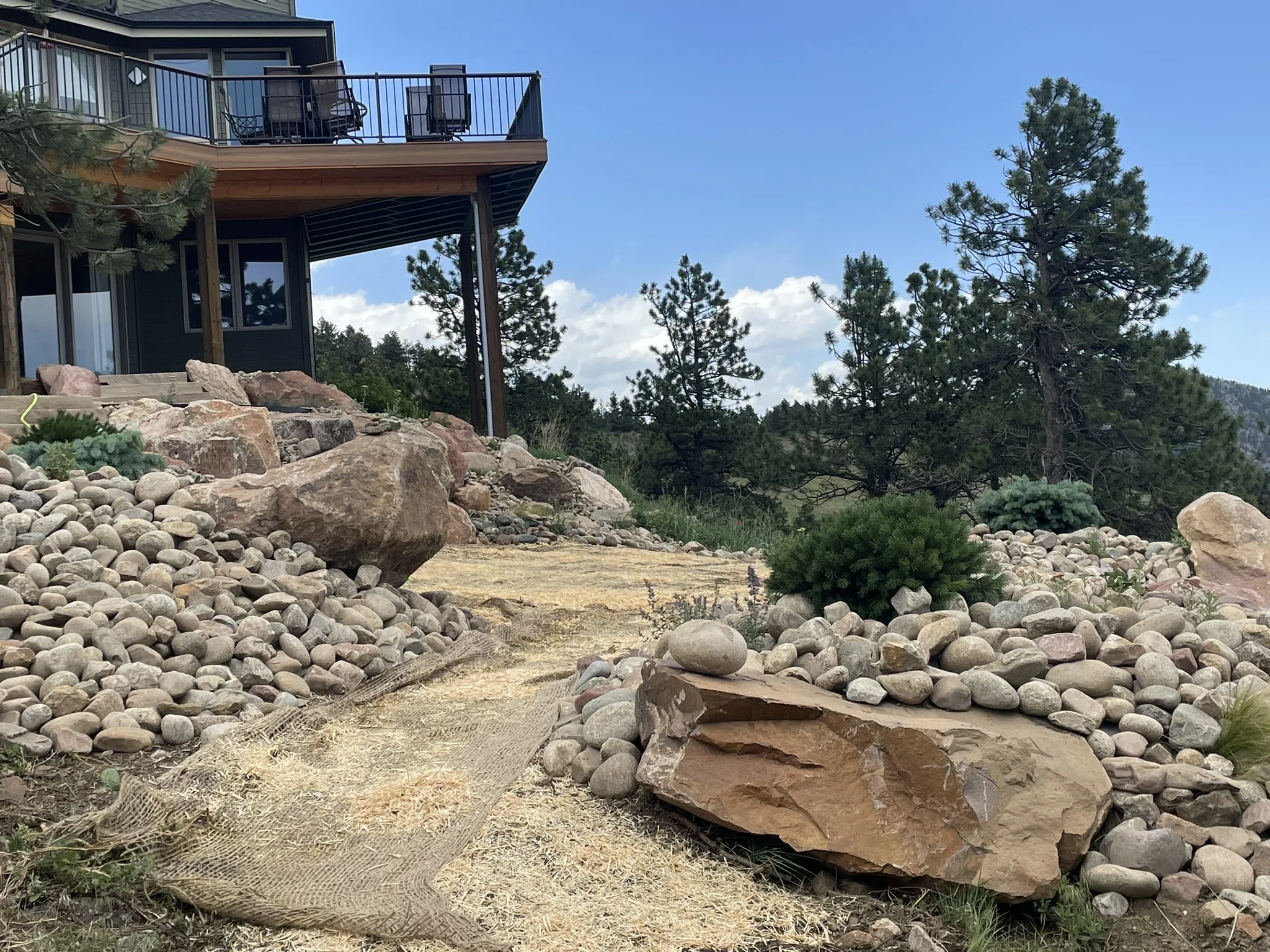
Landscape grading and drainage services reshape the ground surface so water flows where it’s intended to go, away from structures and toward safe discharge points. Everything else in a drainage system, including the pipes, the catch basins, and the swales, depends on grading being correct first. If the slope is wrong, no amount of drainage infrastructure downstream will fully compensate.
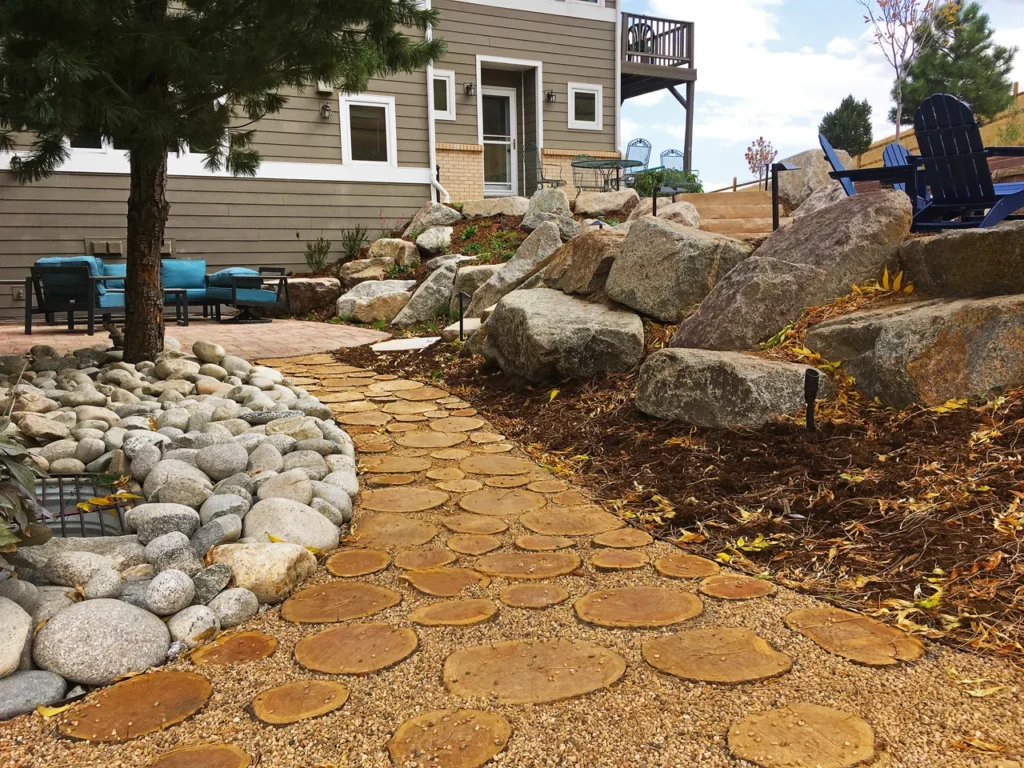
Two specific grading standards matter most for residential properties. Finished grade should slope away from a foundation at approximately 1 inch per foot for at least the first 6 feet, and drainage runs, the channels that carry water across the property to an outlet, typically require 1 inch of fall per 10 feet of length to maintain flow without standing water or sediment buildup.
In Boulder’s clay soils, getting these slopes even slightly wrong has real consequences, because a grade that’s off by half an inch per foot can redirect hundreds of gallons of water toward a structure during a single Front Range thunderstorm. We see this regularly on properties where the original grade was set without accounting for soil settlement or where previous landscaping work flattened a slope that should have stayed pitched.
There are two phases to grading work worth understanding. Rough grading establishes the overall site slope and moves the bulk of the soil to the right position, while finish grading is the final pass that shapes the surface precisely before sod, planting, or hardscaping goes in. Both phases matter, but finish grading in particular requires careful attention because it’s the last opportunity to correct slope before everything gets installed on top of it.
What Happens When Grading Is Done Wrong
When grading is done incorrectly, the problems don’t stay contained. Water that should move away from a foundation instead backs up against it, creating hydrostatic pressure in basement walls, and that pressure causes seepage, cracks, and over time, structural movement. Saturated subsoils beneath a patio or retaining wall, for example, lose load-bearing capacity and begin to shift.
On slopes, misdirected water accelerates surface erosion, stripping topsoil and undercutting plantings. A slope that looks visually correct from the street may still be directing water in the wrong direction by just a few degrees. By the time the problem is visible, the damage is already well underway, and correcting it costs significantly more than getting the grade right in the first place.
Erosion Control in Boulder: Protecting What Grading Creates
Grading reshapes the slope, but bare or destabilized soil on that slope remains vulnerable to surface runoff, wind, and Boulder’s freeze-thaw cycles. Clay soils crack in winter, and those cracks become pathways for water to move through the soil in ways that undermine both the grade and the plants trying to establish above it. Erosion control is what protects the work that grading creates.
Proper erosion control on residential properties typically draws on four primary methods, and the best solutions use more than one in combination.
- Retaining and rock walls: hold soil on steep slopes where grading alone can’t maintain a stable angle of repose, with segmental block walls and natural stone structures both serving this purpose. Natural stone is a common choice on Front Range properties where the aesthetic fits the terrain. Our hardscaping and retaining wall services cover this in detail, including the drainage features that walls need built into them to prevent hydrostatic pressure from building up behind the face.
- Riprap and rock-lined swales: use angular rock placed in drainage channels to slow water velocity and prevent the channel itself from eroding, which is a common solution where water is concentrated and moving fast, such as at downspout outlets or along property edges that receive sheet flow from adjacent lots.
- Erosion control blankets: are biodegradable mats applied to disturbed slopes during the establishment period, typically while new plantings are taking root. They also work to protect bare soil from direct rainfall impact while holding the surface together long enough for roots to do the same job permanently.
- Slope-stabilizing plantings: are the long-term answer to how to prevent soil erosion on Boulder properties, because deep-rooted native and xeric species hold soil with their root systems in a way that blankets and rock cannot replicate. Our xeriscape and planting services include plant selection specifically suited to Front Range slopes, HOA planting restrictions, and Boulder’s water-wise requirements.
Best Plants for Erosion Control on Colorado Slopes
Plant selection for proper erosion control depends on slope grade, sun exposure, soil type, and HOA restrictions, all of which vary significantly across Boulder, Louisville, Erie, and Broomfield communities. These species consistently perform well on Front Range slopes:
- Blue Grama and Buffalo Grass: are native grasses with deep root systems that hold soil through dry spells and heavy rain cycles.
- Apache Plume: is a deep-rooted shrub that tolerates poor soil and slope exposure while providing seasonal interest.
- Rabbitbrush: is drought-adapted with aggressive root spread, making it well-suited to disturbed slopes and clay-heavy soils.
- Creeping Phlox: is a low-growing ground cover that binds surface soil on moderate grades.
Colorado State University’s Extension resources on Front Range garden and landscape design provide additional plant guidance specific to Colorado’s Front Range climate and soil conditions. Plant choices for ways to prevent soil erosion should always account for establishment water needs, since most erosion-control plantings need supplemental irrigation for the first one to two seasons before they’re fully self-sustaining.
Drainage Systems That Work With Your Grading, Not Against It
Drainage infrastructure is the middle layer of the system. Grading tells water where to go, erosion control protects the soil as water moves, and drainage infrastructure provides the actual pathway for water to exit the property without pooling, flooding, or concentrating in areas that can’t handle the volume.
Four drainage solutions apply most commonly to Boulder residential properties:
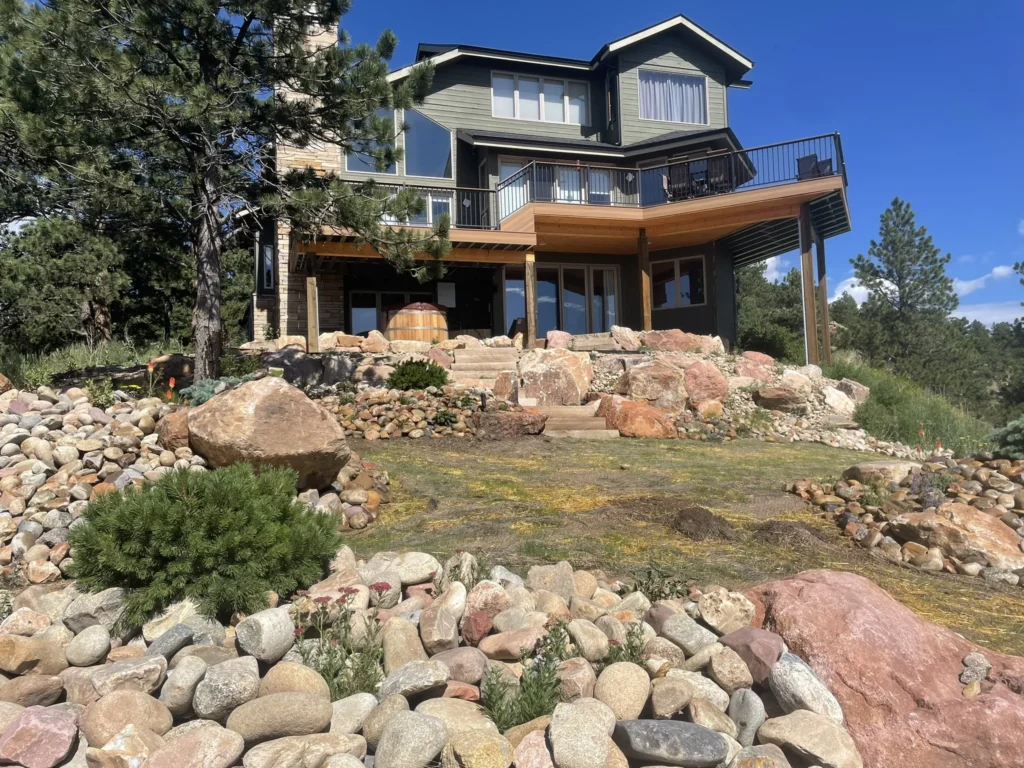
- French drains: handle subsurface water movement by capturing groundwater below the surface and redirecting it through a perforated pipe in a gravel trench, and they’re effective on properties where water tables rise seasonally or where soil saturation below the surface is contributing to soft spots and muddy areas that don’t have an obvious surface water source.
- Catch basins: collect surface water at low points and feed it into underground piping that carries it to a suitable outlet, making them the right solution at the base of a slope or in a low corner of a yard where water reliably concentrates during storms.
- Swales and dry creek beds: convey surface runoff across a property in a controlled channel rather than letting it sheet-flow unpredictably, and dry creek beds in particular serve double duty on Boulder properties because they manage drainage while also fitting the natural aesthetic of the terrain. Landscape grading services that incorporate dry creek design need to account for water velocity at peak flow, not just average conditions.
- Outlet structures: control discharge velocity at the property edge, preventing the exit point of a drainage system from creating erosion on an adjacent slope or neighboring property, and this is a detail that gets missed frequently, which is why we check it specifically during site assessments.
All of these systems need to be sized and sloped based on Boulder’s soil permeability, the specific grade of the property, and the storm intensity this area actually experiences. Drainage design that accounts for a light rain but not a summer downpour will fail when it matters most.
Boulder Permits and Regulations for Grading and Erosion Control Projects
Understanding permit requirements separates landscape grading and erosion control companies that know Boulder’s regulatory environment from those that don’t. According to city regulations, a grading permit is required for projects involving 50 or more cubic yards of cut or fill, and an erosion and sediment control permit is required for construction projects disturbing one acre or more of land.
Many residential drainage projects in Boulder fall just below these thresholds, but that doesn’t mean erosion control planning can be skipped. Boulder County’s grading and revegetation standards, set expectations for revegetation and soil stabilization on disturbed sites regardless of permit requirement, and treating these standards as optional rather than baseline good practice is where projects get into trouble.
The local design/build professionals at Stone & Leaf Landscaping can help with permit documentation and HOA approval in-house. When a formal submittal is needed, CAD drawings can be prepared to meet both city and HOA requirements, removing a significant administrative burden from homeowners, This can avoid the costly delays that come from back-and-forth with review agencies on incomplete submittals.
How Stone & Leaf Landscaping Approaches Boulder Drainage Grading Projects
Owner Hayden Griess has been on the ground in Boulder’s backyards for over 17 years, and the first thing he tells every client is that drainage problems cannot be diagnosed remotely. This is due to the fact that every yard’s slope, soil composition, and runoff pattern is different. Two properties on the same block can have completely different drainage behavior based on how the original grade was set, what’s been done to the yard since, and where the neighbors’ runoff ends up.
Our process starts with an on-site consultation where we observe the actual conditions such as:
- How water moves across the property
- Where it pools
- What the soil does when it’s saturated
- Whether the existing grade is working with or against the drainage system
From there, we design grading, drainage, and erosion control together as one plan, not three separate scopes that get handed off between contractors.
That daily presence is a practical quality-control advantage, not a customer service talking point. Boulder drainage grading and erosion control work is the kind of project where a grade that gets set wrong on day two creates problems that don’t show up until the first big rain, and by then, the fix is far more disruptive than the correction would have been during installation.
Our pricing uses a time-and-materials structure with a 15% do-not-exceed cap, which matters on drainage projects specifically because unexpected soil conditions during grading work are common. Boulder’s subsurface is not uniform, and the cap means that when we hit something unexpected, the budget conversation is clear and controlled, not a surprise invoice at the end.
Stone & Leaf Landscaping holds a 4.7 rating across 96 Thumbtack reviews, has been hired 137 times, and earned Top Pro designations from 2017 through 2020. Reviews that specifically mention regrading, slope work, and drainage reflect the same integrated approach we apply on every project. You can see completed work via our project portfolio page.
Frequently Asked Questions About Grading and Erosion Control in Boulder
How much slope should yard grading have away from a house?
Finished grade should slope away from the foundation at approximately 1 inch per foot for at least the first 6 feet. In Boulder's clay soils, maintaining this pitch is especially important because clay sheds water rather than absorbing it, concentrating runoff directly against the foundation if the grade is flat or slopes inward. Even a slight deviation from this standard can redirect significant water volume toward a structure during a heavy rain event.
How do I know if my property needs regrading?
The most common indicators include:
- Water pooling near the foundation
- Soggy or perpetually soft lawn areas
- Washed-out mulch beds after rain
- Exposed roots on slopes
- Basement moisture following wet periods
Leaning or cracked retaining walls are also a sign that hydrostatic pressure has been building, often from water that has nowhere to go because the grade is directing it toward the wall rather than away from it. A free on-site consultation is the most reliable way to confirm whether regrading, drainage infrastructure, or both are needed for your specific property.
Do I need a permit for grading in Boulder, Colorado?
In Boulder, a grading permit is required for projects involving 50 or more cubic yards of cut or fill, and an erosion control permit is required for projects disturbing one acre or more of land. Many residential drainage projects fall below these thresholds, but proper erosion control planning remains a standard expectation under Boulder County guidelines. Confirm current permit requirements before starting any grading work.
What is the difference between grading and erosion control?
Grading reshapes the ground surface to direct water flow away from structures and toward safe discharge points, while erosion control protects the soil and plantings on that reshaped surface from being displaced by runoff, wind, or freeze-thaw cycles. Grading creates the slope, and erosion control keeps that slope intact over time. Both are required for a drainage solution that holds up through Boulder's seasonal weather cycles, and one without the other will eventually fail.
Start With a Site Visit, Not a Quote
Drainage problems are site-specific in a way that makes remote diagnosis unreliable, because a slope that looks fine from the street may be directing water straight toward a crawl space, and soil conditions vary block by block across Boulder County. What works on a sandy-soil lot in Erie will fail on a clay-heavy slope in the foothills above Boulder, and there’s no substitute for standing on the property, watching where water moves, and reading what the soil and existing grade are actually doing.
That’s where we start on every drainage and grading project. A site visit lets us see the actual problem, not a description of it, and we can identify whether the issue is a grading problem, a drainage infrastructure gap, an erosion control failure, or all three working together before any plan is made or any work is quoted.
Ready to fix your drainage or grading problem? Contact Stone & Leaf today to schedule your free consultation, or call 720-338-3002. Learn more about our grading, erosion control, and site preparation services if you’d like to review what we do before reaching out.
Stone & Leaf has been solving drainage and erosion problems on Front Range properties since 2008, and we bring that experience to every consultation we do.

Leave a Reply