
Boulder Garden Design That Gives Back: Native Plants for Pollinators and Water-Wise Landscapes
If you have been thinking about replacing your turf with something more interesting, more alive, and less thirsty, you are already most of the way to the right answer. Boulder homeowners are increasingly drawn to the idea of a yard that does something, a space that supports wildlife, cuts water bills, and still looks beautiful from the driveway. The good news is that in our climate, those goals are not in tension. They are the same goal.
At Stone and Leaf Landscaping, we have been designing and installing landscapes across Boulder and the Front Range for over 17 years. One of the clearest shifts we have seen in that time is how many homeowners now want their yard to feel ecologically alive, not just maintained. Pollinator gardens and xeriscape designs are the most frequent requests we get from that group. And here is what we tell every one of them: in Boulder, those two things are the same garden, designed with intention.
Why Pollinator Gardens Make Perfect Sense in Boulder
Boulder’s semi-arid climate, high elevation, and often clay-heavy soil are not obstacles to a beautiful yard. They are the design brief. The plants that thrive here naturally, the ones that do not need to be coaxed, coddled, or heavily irrigated, are the exact plants that bees, butterflies, hummingbirds, and beneficial insects evolved alongside.
Traditional turf is increasingly difficult to justify in this environment. It requires significant irrigation during a season when the City of Boulder is actively asking residents to conserve. As of 2026, a new outdoor landscaping code requires watering only before 10 a.m. or after 6 p.m. from May through September, a reflection of how seriously the region is taking water management. A landscape built around native plants sidesteps most of this friction. Once established, these plants largely take care of themselves.
Pollinator populations across Colorado have declined steadily as native plant communities have been replaced by turf and non-native ornamentals. A well-designed Front Range garden can help reverse that on a neighborhood-by-neighborhood basis. It does not require the homeowner to become an ecologist. It requires choosing the right plants, putting them in the right places, and giving them time to establish.
Xeriscaping and Pollinator Design Are the Same Philosophy
There is a persistent myth that xeriscaping means rocks, gravel, and a few lonely cacti. It does not. The term was coined by Denver Water in 1981 and describes a design approach centered on appropriate plant selection, soil health, mulch, and efficient irrigation. Done well, a xeriscape is lush, layered, and full of seasonal color.
The seven core principles of xeriscape, including right-plant-right-place selection, soil improvement, mulching, and limited turf, are essentially a blueprint for pollinator habitat. Native plants are drought-tolerant in this climate because they evolved here. They are also the plants that local pollinators evolved alongside. A landscape that applies xeriscape principles is, almost by definition, a landscape that supports native wildlife.
One more thing worth saying clearly: non-native plants marketed as “pollinator-friendly” often fall short. Many commercially available cultivars have been bred for visual impact and produce altered or reduced pollen and nectar that local bees cannot effectively use. Local native species are the more reliable choice for genuine ecological function.
When a client tells us they want a water-wise yard, and another tells us they want a pollinator garden, we end up recommending nearly identical plant palettes and design approaches. The framing is different. The garden is the same.
The Best Native Plants for a Boulder Pollinator Garden
The goal in any pollinator planting is continuous bloom from early spring through hard frost. A yard that peaks in July and goes dormant by August does not function as a habitat corridor. It functions as a seasonal snack bar. Designing for succession across the whole growing season is the difference between a planting bed and a genuine pollinator garden.
Here is how we think about bloom timing in Boulder-area designs.
Early Season: March through May
- Serviceberry (Amelanchier): One of the first native shrubs to flower in the Front Range, often before the snow is fully gone. Critical for emerging pollinators that have no other food source yet. Edible berries for birds follow in summer, and fall color is genuinely striking.
- Pasqueflower: Low-growing, delicate-looking, and tougher than it appears. One of the first perennials to push through in Boulder. Native bees seek it out immediately.
- Native Willows (where drainage allows): Among the earliest pollen sources available in spring, important for native bees coming out of overwintering.
Mid Season: June through August
- Penstemon (multiple species): The workhorse of any Front Range pollinator garden. Hummingbirds specifically target it. Different species bloom from May through August, so stacking two or three varieties extends the window considerably. It handles Boulder’s clay and caliche conditions better than most plants we work with.
- Blanket Flower (Gaillardia): Long bloom window, intense color, and extremely drought-tolerant once established. Native bees and butterflies are on it constantly through the heat of summer.
- Yarrow (Achillea millefolium): Flat-topped flower heads function as landing platforms for a wide range of beneficial insects. Remarkably durable in Boulder’s challenging soil. Spreads gradually and fills gaps beautifully.
- Rocky Mountain Bee Plant: An aggressive, cheerful bloomer that native bees love. Self-seeds freely, which we think of as a feature rather than a problem in a naturalistic design.
Late Season: September through Frost
- Rabbitbrush (Ericameria nauseosa): In our experience, this is the single most underused and most valuable plant in Front Range pollinator design. It blooms when almost nothing else does, in that September-October window when pollinators are preparing for winter and have very few food sources available. Monarch butterflies use it heavily during fall migration. It is tough, xeric, and visually striking when it goes gold in early fall.
- Autumn Joy Sedum: Long-lasting bloom, attractive to late-season bees, and holds its structure and seed heads through winter for visual interest.
- Blue Grama Grass: A native grass that provides seed for birds and nesting material for ground-nesting bees through the dormant season. Unpretentious and hardworking.
Plant diversity is not just aesthetically interesting. It is ecologically essential. A yard with staggered bloom across the full season functions as a reliable food corridor for pollinators. A yard that blooms only in midsummer does not.
How to Design a Pollinator Garden That Looks Intentional
A pollinator garden that earns its place in a Boulder neighborhood is not a random collection of native plants. It is a designed landscape that happens to be ecologically functional. The design thinking is the same as any other project we take on: structure, layering, proportion, and seasonal interest come first. The plant list follows from those decisions.
We work with a four-layer framework in most of our xeriscape and pollinator designs:
- Ground cover layer: Creeping thyme, native sedges, and low-growing penstemons. These suppress weeds, retain moisture, and provide nesting material for ground-nesting bees.
- Perennial layer: The primary bloom layer and where most of the pollinator activity happens. This is where succession planning matters most.
- Shrub layer: Serviceberry, rabbitbrush, native currant. Provides structure, wind protection, nesting sites, and extended bloom from early spring through fall.
- Tree and large shrub layer: Gambel oak, native chokecherry, hawthorn. Long-term canopy structure, caterpillar host plants, and shelter for birds.
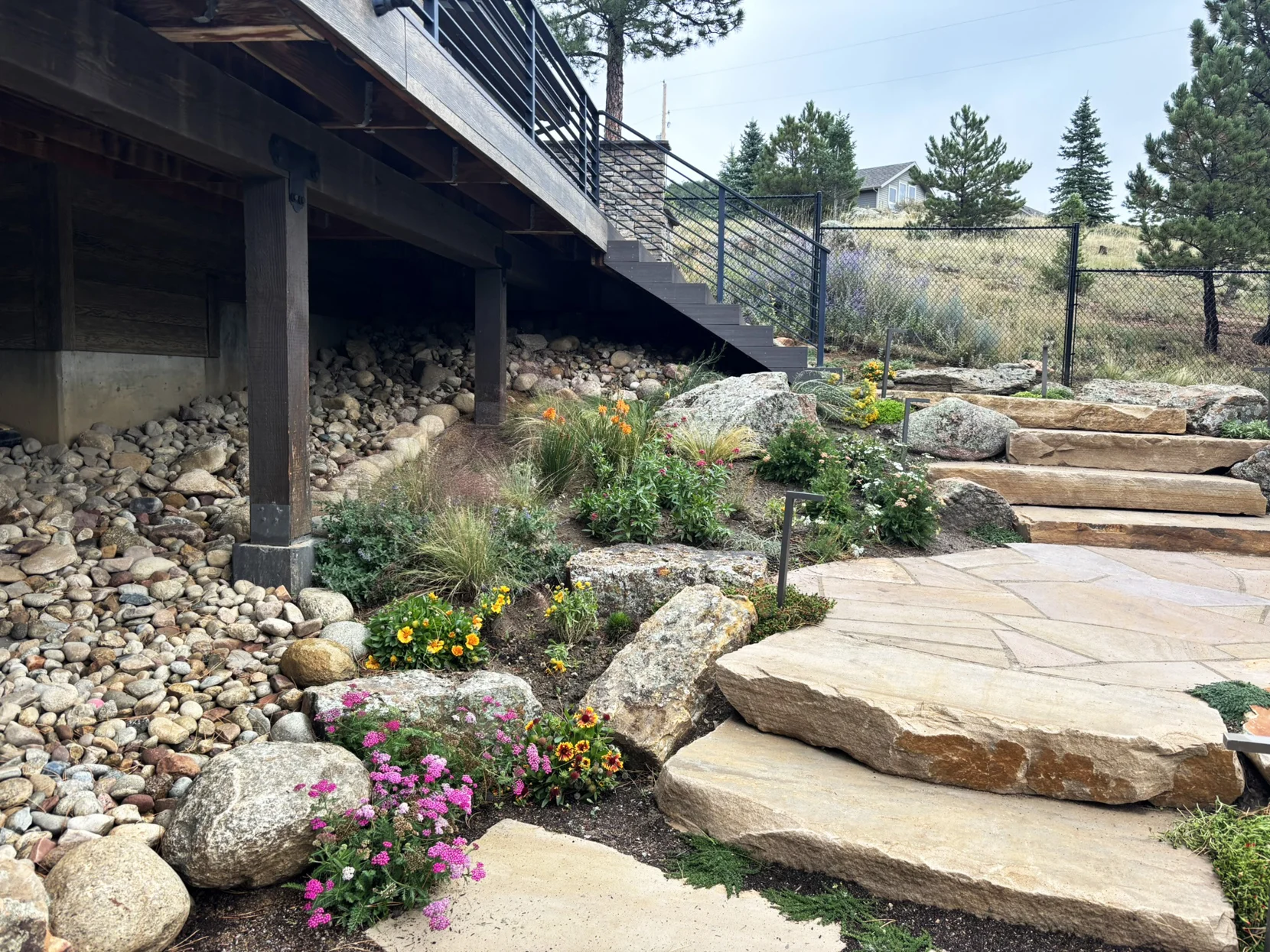
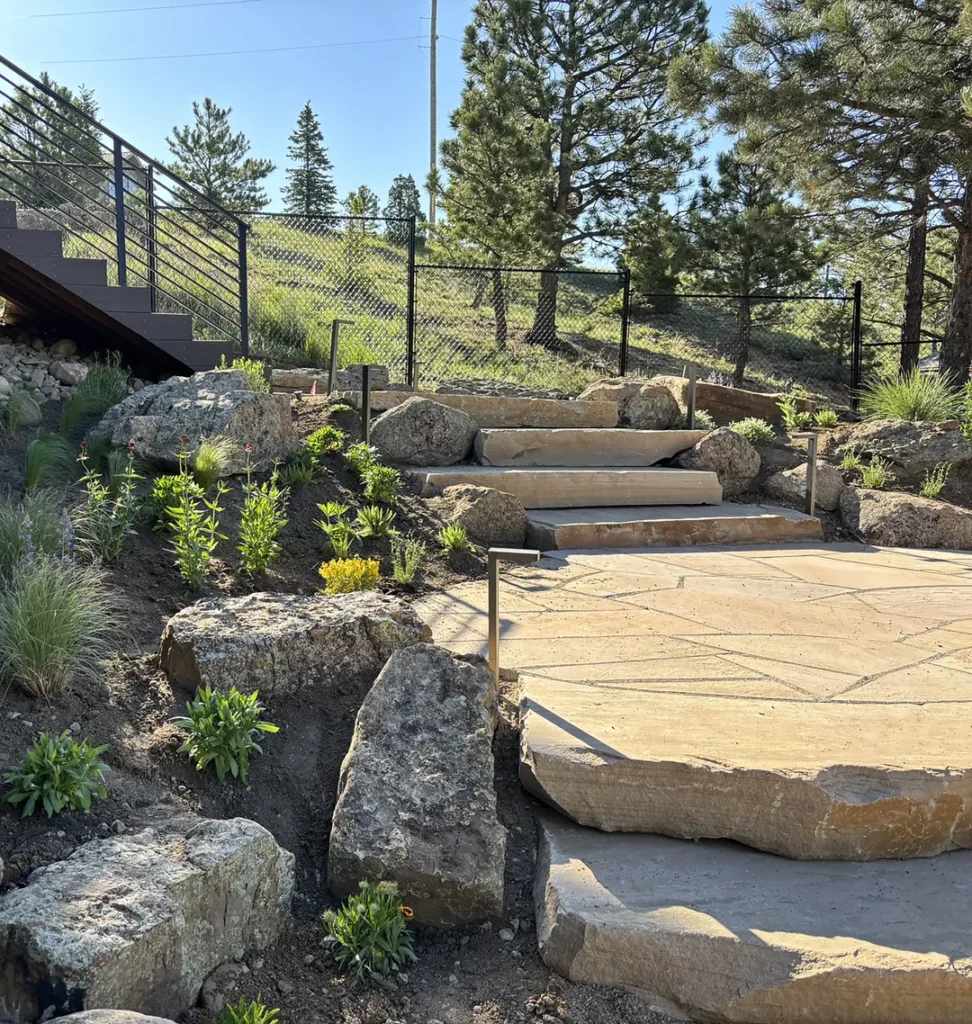
Different pollinator species feed, nest, and shelter at different heights. A layered design supports a wider range of wildlife than a flat planting bed, and it looks more refined and finished as a result. We also use boulder accents and natural stone elements to create thermal mass and sheltered microclimates, which both improve habitat and add design interest.

Soil, Mulch, and Irrigation: Getting the Foundation Right
Front Range soil is often clay-heavy, and caliche layers appear at varying depths across Boulder-area properties. Native plants handle this better than turf or ornamentals, but soil prep during installation still matters for establishment.
A few principles we apply on every project:
- Amend with compost at planting. This improves drainage in clay without over-lightening the soil. Native plants do not need rich growing conditions. They need workable ones.
- Mulch at 2 to 3 inches. Wood chip mulch around plantings reduces evaporation, moderates soil temperature, and suppresses weeds. Leave some small patches of bare or loosely mulched ground. Ground-nesting native bees, which make up a significant portion of Colorado’s native bee diversity, need exposed soil for nesting.
- Skip the weed barrier fabric. The City of Boulder’s own landscaping guidance does not recommend it, and we agree. It increases heat, restricts root growth, and blocks organic matter from reaching the soil. Mulch does the job better without the downsides.
- Use drip irrigation during establishment. Even drought-tolerant natives need supplemental water for the first one to two growing seasons. A drip system with zone-specific control is the right tool. Once plants are established, typically by the end of year two, most Front Range native plantings can transition to minimal or no supplemental irrigation. That is the payoff.
A Less Perfect Garden Is Often a Healthier One
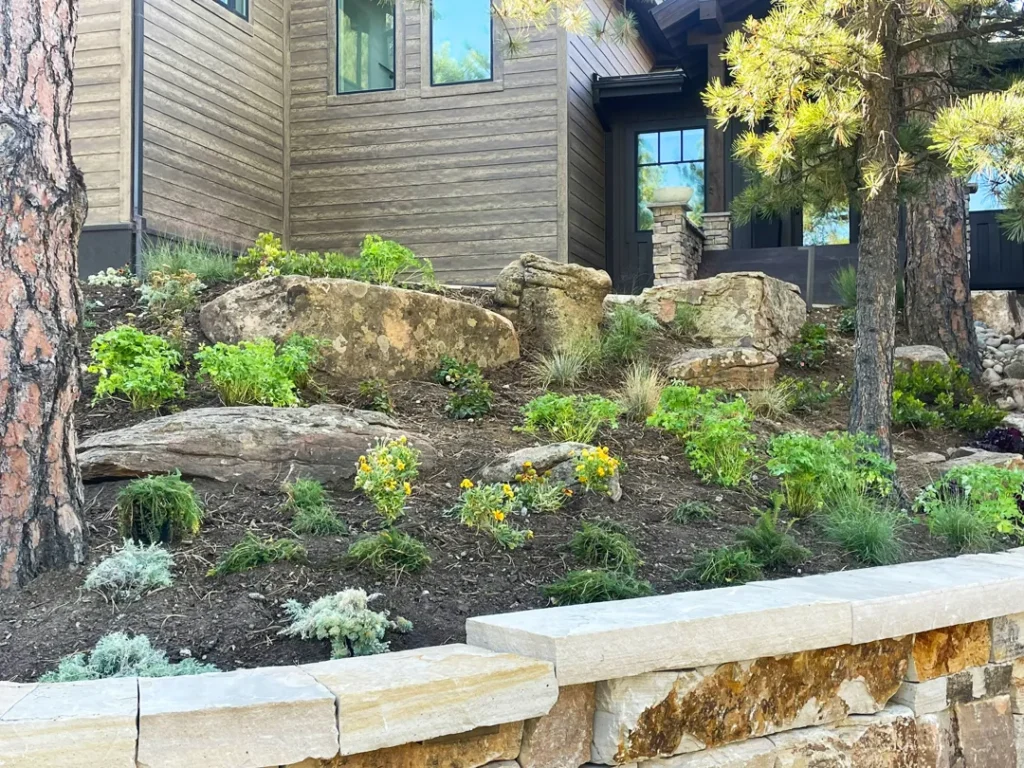
This is the advice that surprises some clients but tends to stick with them. A pollinator garden that looks slightly less groomed than a conventional landscape is not an unfinished yard. It is a functioning ecosystem.
Pesticides and herbicides are incompatible with a pollinator garden. This is not a stylistic preference. Many systemic pesticides persist in pollen and nectar and directly harm the insects the garden is designed to support. The alternative is to let the garden develop its own natural balance. A healthy native planting attracts predatory wasps, lacewings, and ground beetles that manage pest populations without any chemical intervention.
Leave seed heads through winter. They feed birds, provide visual structure in an otherwise dormant landscape, and are a sign of ecological awareness, not neglect. Allow some undisturbed soil. Resist the urge to tidy every corner.
For homeowners with HOA requirements, this does not have to be a conflict. We have navigated HOA-compliant native and xeriscape designs many times in Boulder, Louisville, Lafayette, and surrounding communities. CAD documentation and HOA submittal support are part of what we bring to a project. A well-designed native yard can be structured, intentional-looking, and fully compliant.
Ready to Design a Boulder Yard That Gives Back?
The best Boulder garden design is one that works with this climate rather than against it. Native pollinator plants and xeriscape principles are not two separate strategies. They are the same approach, and when they come together in a well-designed landscape, the result is a yard that saves water, supports local wildlife, and becomes more beautiful and dynamic with every passing season.
We bring 17 years of Front Range experience to every consultation, including specific knowledge of how Boulder’s soil and microclimates affect plant performance, how to design for the full growing season, and how to navigate HOA requirements when they are part of the picture.
If you are ready to explore what a pollinator-friendly xeriscape could look like in your yard, we would love to talk. Our consultations are free, on-site, and come with honest guidance on what is possible, where to start, and what it will realistically cost.
Visit our Xeriscape and Planting services page to see examples of our work, explore our full range of services, or book your free on-site consultation directly. We will bring the plant knowledge, the design thinking, and the tape measure.
Stone and Leaf Landscaping. Boulder-based. Owner on site. Your Dream Landscape, Realized.

Leave a Reply